
As an Amazon Associate, we earn from qualifying purchases. This post contains affiliate links; buying through them costs you nothing extra.
If you live with more than one cat, you already know that mealtime is rarely a calm, orderly event. One cat inhales its portion in ninety seconds and then goes shopping in the other bowl. The slow eater backs off. Over a few months, one cat is heavier than it should be and the other is quietly underfed. Choosing the right automatic cat feeder for multiple cats is the single change that fixes most of this, but only if you pick for the right reasons.
This guide covers how to choose an automatic cat feeder when you live with more than one cat: the seven things that actually matter when you are feeding two or more cats from a machine, the mistakes that send people back to Amazon for a second feeder six weeks later, and how to match a feeder to the household you actually have.
Short on time? Start with one of these 3 feeders
- Best for 2 cats on a schedule
oneisall Dual-Bowl Feeder
Two separate bowls fill at the same time, so the faster cat cannot eat both portions.
- Best for short trips
Gardner Pet Gravity Set
Gravity food and water stations with stainless bowls: no power, nothing to program.
- Best budget pick for grazers
Amazon Basics Gravity Set
A matching food-and-water pair for cats that nibble through the day rather than eat set meals.
Need a microchip, RFID or wet-food feeder instead? Compare all seven in our best automatic cat feeders for multiple cats.
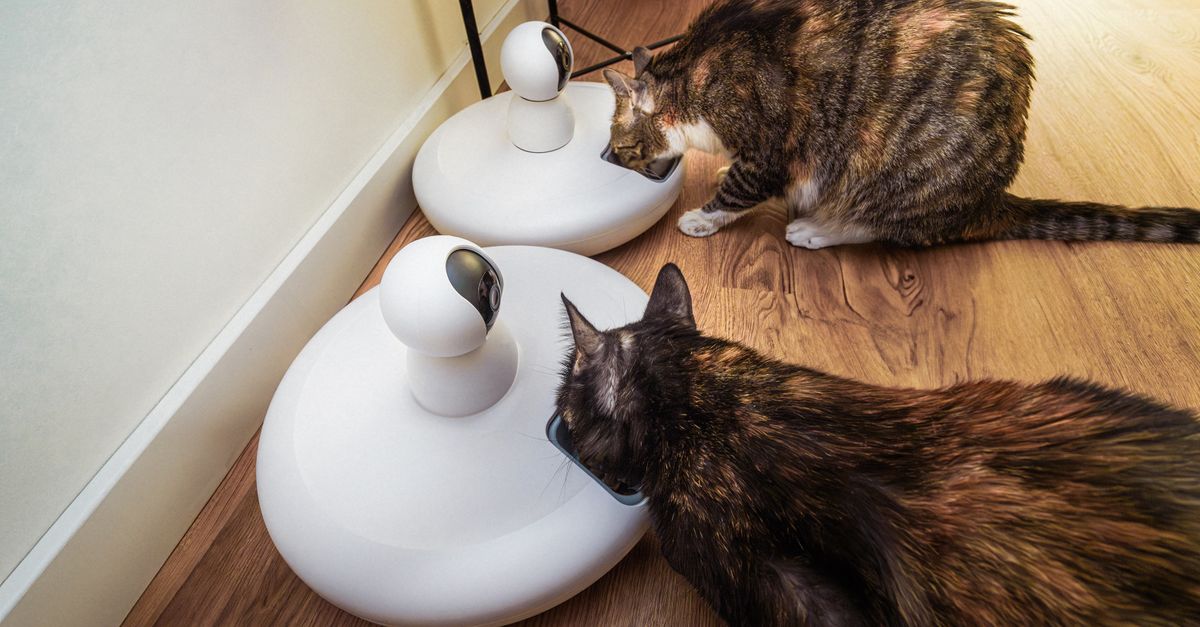
The Three Feeders We’ve Reviewed — and Who Each One Fits
The seven criteria further down are what you should judge any feeder on. If you would rather start from a shortlist, these are the three multi-pet feeders we have reviewed in full so far. Read the one that matches your household — each review covers setup, daily use, and what owners most often complain about. For a wider shortlist, see the best automatic cat feeders for multiple cats, where we compare seven models.
| Feeder | Type | Best suited to | Where to buy |
|---|---|---|---|
| oneisall dual-bowl automatic feeder | Programmable timer | Two cats that need separate, measured portions on a schedule | Check on Amazon |
| Amazon Basics gravity feeder + water set | Gravity, no electricity | Grazing cats, and households that want a matching water dispenser | Check on Amazon |
| Gardner Pet gravity feeder + water set | Gravity, no electricity | Short trips — holds food and water for up to seven days for small pets, stainless steel bowls | Check on Amazon |
If you need portion control: the oneisall dual-bowl
This is the only one of the three that dispenses measured meals on a timer, and it drops them into two separate bowls — which is exactly the “one eating station per cat” point in section 1. It is the sensible starting point when one cat eats fast and the other gets pushed off the bowl. Read the full oneisall dual-bowl review.
View the oneisall dual-bowl feeder on Amazon to check current availability and bowl capacity.
If you want zero electronics: the two gravity sets
A gravity feeder cannot portion-control. It keeps the bowl topped up until the hopper runs out, which makes it a poor fit for a cat that overeats and a good fit for cats that graze, or as a second food and water station elsewhere in the house. The Amazon Basics set pairs a kibble hopper with a matching water dispenser and needs no batteries or Wi-Fi at all. The Gardner Pet set is the one we would take for a weekend away — it holds up to seven days of food and water for small pets and uses 304 stainless steel bowls that rinse clean in minutes.
Availability on Amazon: Amazon Basics gravity feeder and water set · Gardner Pet gravity cat feeder set.
Worth being straight about: none of these three has per-cat microchip recognition. If one of your cats raids the other’s bowl no matter what you do, a gravity feeder will make that worse, and even a dual-bowl timer feeder only helps if you place the bowls far apart. Section 1 explains why that matters more than any feature on a spec sheet.
That gap runs across the whole category. In our automatic pet feeder study of 300 Amazon listings, only 6 of the 39 feeders marketed for two or more cats say how they tell the cats apart.
Why Feeding Multiple Cats Is a Different Problem
Most feeders on the market are designed around one assumption: one machine, one cat, one bowl. Drop that same machine into a two- or three-cat home and three things go wrong almost immediately.
First, the fastest eater wins. Cats do not take turns. Whichever cat reaches the bowl first eats until it is interrupted, which means the portion you carefully programmed is no longer a per-cat portion — it is a per-household portion, unevenly split.
Second, you lose visibility. With a shared bowl you cannot tell who ate what. Appetite change is one of the earliest signals that something is wrong with a cat, and a shared bowl hides it completely.
Third, guarding behavior builds. A resource that appears at a predictable time in a single location is exactly the kind of resource cats learn to defend. Feeding from one point can turn a mild hierarchy into daily tension.
A good automatic cat feeder for multiple cats is not simply a bigger feeder. It is one that keeps portions separate, keeps eating locations separate, and keeps running when you are not there to supervise.
1. One Eating Station Per Cat — Not One Bowl
This is the rule that matters most, and it is where dual-bowl feeders and multi-unit setups differ.
A dual-bowl feeder dispenses from one hopper into two separate bowls at the same time. Both cats eat simultaneously, in their own spot, without racing each other. This solves competition and it solves the scramble — it is the right answer for most two-cat households where both cats eat the same food in similar amounts.
What a dual-bowl unit does not give you is truly independent portioning. Both bowls are fed from the same program. If one of your cats is on a weight-management plan and the other is not, or one eats prescription food, you need two separate feeders placed in different rooms instead — or a microchip-activated feeder that only opens for one specific cat.
A quick way to decide: if both cats eat the same food and roughly the same amount, one dual-bowl feeder is enough. If their diets differ in food type or quantity, budget for one feeder per cat.
2. Portion Precision, Not Just Portion Size
Every automatic cat feeder for multiple cats advertises programmable portions. The number that matters is the smallest increment it can dispense, and how consistent that increment is meal to meal.
Cats eat small amounts often. A typical adult cat eats somewhere around a quarter to a third of a cup of dry food per day, split across several meals. A feeder whose smallest step is a full quarter-cup gives you almost no room to tune portions, and a feeder that varies by 20% per dispense will quietly overfeed one cat over a month.
Look for a feeder that dispenses in small, repeatable units and lets you set at least four meals a day. More frequent, smaller meals also reduce the gulp-and-vomit pattern that fast eaters fall into.
3. Hopper Capacity Versus Food Freshness
Bigger is not automatically better. A large hopper — 5 liters or more — is genuinely useful in a multi-cat home because you are dispensing two to three times as much food per day, and refilling every second day gets old fast.
But dry food degrades once it is exposed to air and warmth. Fats oxidize, palatability drops, and cats notice before you do. The practical target is a hopper you empty roughly every one to two weeks, not one you fill to the brim and forget. If a 5-liter hopper would take your household a month to get through, fill it halfway.
Check two other things while you are looking at the hopper: whether the lid seals properly, and whether the unit has a desiccant or freshness compartment. A sealed lid also matters for a second reason — a determined cat will get into an unsealed hopper.
4. Power Backup Is Not Optional
This is the feature people skip and then regret. A mains-powered feeder with no battery backup does not just stop dispensing during a power cut — many models also lose their programmed schedule, so when power returns the feeder sits idle until you reprogram it.
If you are away for a weekend, that is two days of no food for two cats. Any feeder you are trusting while you are out of the house should have battery backup that keeps both the clock and the schedule alive.
5. Anti-Jam Dispensing and Kibble Size
A jammed automatic cat feeder for multiple cats means a missed meal, and in a multi-cat home a jam usually happens at the worst possible time — the day you are traveling.
Jams come from a mismatch between the dispenser and the food. Most feeders are built for round kibble in a narrow size band, typically around 5 to 15 millimeters. Flat, triangular or oversized kibble bridges across the outlet and stops the flow. Before you buy, check the feeder’s stated kibble size range against the food your cats actually eat, and prefer units with a rotating anti-jam mechanism rather than a simple gravity chute.
Two more practical notes: almost no dry-food dispenser handles wet food, and semi-moist food will clog nearly all of them. If your cats are on wet food, you want a chilled multi-meal tray feeder, which is a different category entirely.
6. Voice Recording and Remote Alerts
The voice recorder sounds like a gimmick until you use it. A short recording of your own voice playing at each dispense does two useful things: it gives cats a consistent cue that food is arriving, which speeds up adaptation to the new routine, and it keeps a familiar sound in the house while you are out.
Remote alerts are the step up. A Wi-Fi feeder can tell you that a meal dispensed — or that it failed to. If you travel regularly, that notification is the difference between finding out on day one and finding out on day four.
This is the natural split between what we call a Tier 1 “peace of mind” feeder and a Tier 2 smart feeder. Tier 1 handles the schedule reliably and costs less. Tier 2 adds app control, dispense confirmation and often a camera, and is worth it if you are away overnight often or if one of your cats has a medical reason to eat on schedule.
7. Cleaning — the Feature You Use Most
You will clean an automatic cat feeder for multiple cats far more often than you will program it. In a multi-cat home the bowls need washing every day or two, and the hopper and chute need a proper clean every few weeks.
Look for removable, dishwasher-safe bowls, a hopper that lifts out rather than being fixed to the electronics, and a stainless steel bowl option if either of your cats has feline acne or a plastic sensitivity. Feeders that cannot be taken apart get skipped, and a chute with stale food residue is exactly where mold starts.
Matching a Feeder to the Household You Actually Have
| Your situation | What to buy |
|---|---|
| 2 cats, same food, same portions | One dual-bowl feeder with battery backup |
| 2 cats, different diets or portions | Two separate feeders in different rooms |
| 3+ cats | One feeder per cat, or microchip-activated feeders |
| One cat needs weight management | Microchip feeder for that cat, standard feeder for the rest |
| You travel overnight regularly | Tier 2 Wi-Fi feeder with dispense notifications |
| Cats on wet food | Chilled multi-meal tray feeder, not a dry dispenser |
Four Mistakes to Avoid When Feeding Multiple Cats
Buying one feeder and hoping the cats sort it out. They will sort it out — in favor of the faster cat. Separate stations are not a luxury in a multi-cat home.
Programming the same total as the old free-feeding bowl. Free-fed cats usually eat more than they need. Work out the daily amount from your food’s feeding guide and your cat’s target weight — the Cornell Feline Health Center is a good reference for feline nutrition basics — then split it across meals.
Switching everything at once. Put the feeder in place unplugged for a few days with the bowls filled by hand, then start the schedule. Most cats adapt within three to four days; a suspicious cat may take two weeks.
Placing both bowls side by side. If you are using a dual-bowl unit, position it so the two bowls face away from each other or sit at either end of the unit, and give each cat a clear escape route. Cats that feel cornered while eating will not settle.
A Note on Health and Portion Size
An automatic cat feeder for multiple cats is a management tool, not a medical one. If a cat suddenly eats much more or much less, starts vomiting after meals, loses weight while eating normally, or begins guarding food aggressively when it never did before, that is a reason to call your veterinarian rather than adjust the schedule. Separate feeding stations make these changes far easier to notice, which is one of the quieter benefits of getting the setup right. Cats waking you for food at night are worth reading up on separately — we cover that pattern in why your cat wakes you up at night.
FAQ
Can two cats share one automatic feeder?
Only if it dispenses into two separate bowls and both cats eat the same food in similar amounts. A single-bowl feeder shared by two cats recreates the exact competition you are trying to remove.
How many meals a day should I program?
Four smaller meals suits most adult cats better than two large ones. It matches how cats naturally eat, reduces gulping, and spreads the day out so no single meal is worth guarding.
Will an automatic feeder stop my cat waking me at 5am?
Often, yes — if you schedule a meal for the time your cat currently wakes you. The cat learns the food comes from the machine, not from you.
Do I still need to watch my cats eat?
Check in a few times a week. Separate stations make it easy to see who finished and who did not, and that is the information a shared bowl hides.
What about water?
Feeding on a schedule tends to make water intake more important, not less. A fountain encourages most cats to drink more — the filters matter more than the fountain itself, which we cover in our guide to cat fountain filters.
Where to Start
For most two-cat households, the practical starting point is a dual-bowl feeder with a sealed hopper, battery backup and dishwasher-safe bowls — the Tier 1 setup that removes the morning scramble without adding an app to your life. If you want to see how that works in practice, we broke one down in detail in our review of the oneisall dual-bowl automatic cat feeder for 2 cats.
If that description matches your household, the oneisall dual-bowl automatic feeder is here on Amazon. If your cats graze rather than gulp, start with a gravity set instead: Amazon Basics or Gardner Pet.
Once you know which of the seven criteria above actually apply to your household, the shortlist gets very short very quickly.
Related reading: Automatic Cat Feeder for 2 Cats: oneisall Dual-Bowl Review and My Cat Keeps Waking Me Up at Night — Why It Happens and How to Actually Fix It.
The Smart Cat Owner’s Gadget Checklist
20 gadgets worth owning, 8 to skip, and how to choose the right one — sent straight to your inbox.